
You twisted an ankle at pickup, or your knee has been complaining since Saturday’s run, and now you’re standing in the drugstore aisle staring at a wall of athletic wraps — stretchy rolls, sticky rolls, and colorful strips. They all promise “support.” They are not the same thing, and grabbing the wrong one means either too little support or a wrap that’s tighter than it should be.
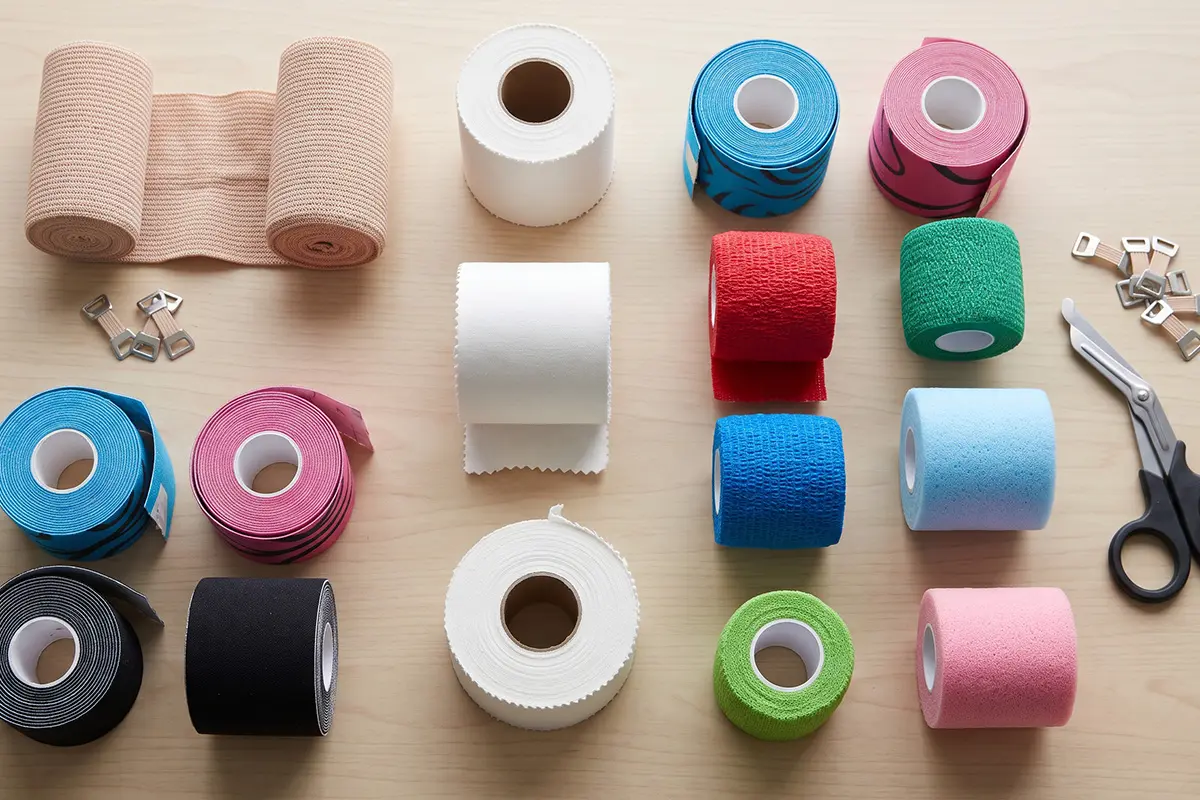
Here’s the good news: the aisle only looks complicated. There are really just six categories of wraps and tapes, each with a clear job. Most people know them by brand nicknames — Ace, Coban, KT tape, vet wrap — rather than by what they do. This post translates the nicknames, explains each category in plain English, and finishes with a simple what-to-use-when guide for the situations that send people to that aisle in the first place.
Skimmers, this table is the whole story. The sections below add the “why” — including safety rules that don’t fit in a grid — so you can pick with confidence instead of guessing.
| Type | Also called | Stretch? | Sticks to skin? | Reusable? | Best for | Not ideal for |
| Elastic bandage | Ace bandage | Yes | No (clips or Velcro) | Yes | Light compression; holding ice or dressings in place | Staying put during activity — support loosens as you move |
| Compression wrap | Self-adhering wrap | Yes | No — sticks to itself | Yes | Adjustable, even compression for swelling, sore muscles, and joints | Rigidly limiting a joint’s movement |
| Cohesive bandage | Coban, vet wrap | Yes | No — sticks to itself only | Mostly no | Quick light wraps, over dressings, holding things in place | Sustained firm compression — can tighten as you move |
| Rigid athletic tape | Athletic tape, zinc oxide tape, strapping tape | No | Yes (usually over pre-wrap) | No | Limiting movement to protect a joint — ankles, wrists, thumbs | Anything that needs to stretch, compress swelling, or move freely |
| Kinesiology tape | KT tape, K-tape | Yes | Yes | No | Light support and comfort that moves with you | Restricting a joint; holding dressings |
| Pre-wrap / underwrap | Foam underwrap, foam pre-wrap | Slight | No | No | Protective layer between skin and rigid tape | Standalone support — it has none |
The elastic bandage is the beige stretchy roll with the metal clips (or Velcro) that most medicine cabinets have held since forever — the category everyone calls an Ace bandage, after the best-known brand.
What it does is light compression and holding things in place: keeping an ice bag against an ankle, securing a gauze pad over a scrape, giving a mildly sore wrist a gentle, snug feeling. It’s reusable, cheap, and utterly ordinary — in a good way.
Its limitation is the same as its strength. Because it’s a stretchy roll held by a clip, it loosens as you move. Walk around for an afternoon and the wrap that started snug is now a soft sock. That’s fine for ice and light comfort, and wrong for anything that needs dependable support during activity. Elastic bandages are also easy to apply too tightly — more tension feels more supportive, but it isn’t, and it can become uncomfortable fast.
If the elastic bandage is the loose sweatshirt of the wrap world, the compression wrap is the tailored jacket. Compression wraps are purpose-built for even, adjustable compression — that held, supported feeling around swelling, sore muscles, and tired joints — and they’re the natural home of what HealiT makes.
The design difference matters. A self-adhering compression wrap sticks to itself rather than to skin or hair, so there are no clips, no pins, and no adhesive residue. You tear it to the length you need by hand, wrap with even overlap, and press the end down to secure it. Because you set the tension yourself, you can make it snug on a sore calf after a long run and gentler a few days later as swelling calms down — or re-adjust it mid-day if it doesn’t feel right. A quality wrap maintains its tension as you move and is reusable.
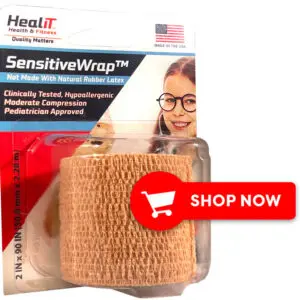
Where it fits: Everyday support on sore or tired areas, workout and recovery support, travel, and the general “I want this to feel held” occasions. SuperusGrip is HealiT’s firmest option — double-thread cotton built for a secure, snug hold during activity and recovery. ColorBurst gives moderate compression in bright colors, and SensitiveWrap is the gentle choice for skin that’s easily irritated. All are breathable cotton, made in the USA.
Where it doesn’t fit: Holding a joint rigidly. A compression wrap supports comfort and compression; it doesn’t lock an ankle in place the way rigid tape does. (More on the difference in Compression Wraps vs. Kinesiology Tape: Understanding the Differences and Benefits.)
The cohesive bandage is the category most people meet by nickname: Coban (a 3M brand name) in the first-aid aisle, or vet wrap at the farm store — same product, different packaging. If you’ve wrapped a horse’s leg or seen a trainer quickly wrap an ankle in a colored roll with no clips, that’s this.
Its party trick is sticking to itself but not to skin, hair, or anything else. That makes it fast and comfortable to apply over dressings, and a favorite for holding a bandage in place without tape or adhesive anywhere near the wound. It’s light, flexible, and tears cleanly by hand.
Two honest cautions. First, because it clings to itself aggressively, a cohesive wrap can subtly tighten as you move and the layers settle — which is the last thing you want on a freshly injured, swelling limb. Check it after an hour of activity and loosen it if anything feels pinched, numb, or tingly. Second, like elastic bandages, it’s a comfort-and-holding tool, not rigid support. Most cohesive wraps are single-use; once unwrapped, they don’t re-adhere as well.
Traditional athletic tape — often called strapping tape or zinc oxide tape — is the stiff white or tan cloth tape you’ve seen wrapped around ankles before every soccer and basketball game.
Its job is the opposite of everything above: rigid strapping tape has virtually no stretch and is built to physically restrict how far a joint can roll, acting like a soft cast that protects injured ligaments while still letting you play. It’s the heavy-duty option for ankles, wrists, and thumbs that need strict motion control.
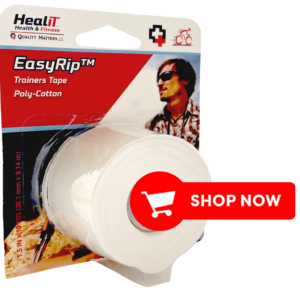
Not every tape job needs that kind of rigid lockdown, though. Traditional poly-cotton trainer’s tape — like HealiT’s EasyRip Sports Tape — pairs a strong, sweat-resistant adhesive hold with a lighter, more flexible weave that conforms to joints and moves with you rather than locking you down completely. It also tears cleanly by hand, making it far more forgiving for quick sideline wraps, finger support, or everyday joint stability when you still want natural mobility.
The trade-offs for all adhesive athletic tapes: they stick to skin (usually applied over pre-wrap, more on that below), they’re single-use, and getting the right tension and anchor points takes practice. If you’re taping an unstable joint for the first time, it’s worth having an athletic trainer show you once.
Kinesiology tape — known by the brand nickname KT tape, or just K-tape — is the stretchy, often brightly colored tape you see striped down runners’ calves and across shoulders at any race.
What is kinesiology tape used for? Light support and comfort during movement. Unlike rigid tape, it’s designed to stretch and move with you — the elastic cotton strip lifts the skin slightly and goes where the muscle goes. People use it on sore shins, cranky knees, tired calves, and shoulders when they want support that doesn’t restrict motion. It’s popular with runners for exactly that reason: support you can run in.
One honest note: clinical studies on how much kinesiology tape changes physical outcomes are mixed. Many athletes report that it helps comfort and body awareness — that experience is real and worth respecting — but treat it as comfort support, not injury repair.
The athletic tape vs. kinesiology tape question comes down to this: rigid tape restricts, kinesiology tape reminds. It doesn’t lock a joint the way rigid tape does, and it isn’t meant to hold a dressing in place. It sticks directly to skin (no pre-wrap), typically lasts through several days of showers, and is single-use. Application has a learning curve — the strips go on along the muscle in specific patterns, and an athletic trainer or physical therapist can show you the ones worth knowing.
We go deeper on how it compares with wraps in Compression Wraps vs. Kinesiology Tape: Understanding the Differences and Benefits.
If rigid tape is the plaster, pre-wrap is the paint primer. Pre-wrap (also called underwrap or foam underwrap) is the thin, slightly spongy foam roll that trainers wind around an ankle or wrist before the rigid tape goes on.
Its job is protection: a soft barrier between skin and adhesive that prevents the chafing, irritation, and post-game waxing that direct taping can cause. It also makes removal far more comfortable and lets you build up slightly contoured areas (like the arch of a foot) so the tape sits smoothly. It has no support value of its own — it’s purely the base layer underneath. HealiT’s ProFoam Underwrap is the soft, cushioning version, and we cover it in detail in The Athlete’s Guide to Underwrap.
A useful tidbit: many people also use pre-wrap as a light headband or to keep shoelaces and hair in place — it clings to itself gently and stays put. Trainers’ trick, works at home too.
For a fuller kit-by-kit rundown of what to pack, see What to Keep in Your Athlete’s Gym Bag: Essential Tapes and Wraps.
Whatever you reach for, the fit rules are the same. A wrap or tape should feel snug and supported, never painful. A quick check is the two-finger test — you should be able to slide two fingers comfortably under the wrap. If you can’t, it’s too tight.
Take it off or rewrap it more loosely right away if you notice:
A few habits worth keeping: don’t sleep in a compression wrap unless a healthcare provider has advised it (overnight wear is a different conversation, which we cover in Should I Wear a Compression Wrap to Bed?), rewrap elastic bandages and cohesive wraps when they loosen or tighten, and replace any wrap or tape that’s wet, dirty, or losing its stretch.
When to see a professional: Get a suspected sprain evaluated if you heard or felt a pop, can’t bear weight, notice the joint looks deformed, or have severe or worsening pain and swelling. Severe pain, numbness, or a cold, blue, or gray limb requires urgent medical attention. When in doubt, get it looked at before you wrap it up and push through.
Six tools, six jobs: elastic bandages for light compression and holding things in place, compression wraps for adjustable everyday support, cohesive bandages for quick self-sticking wraps over dressings, rigid tape for limiting a joint’s movement during sport, kinesiology tape for light support that moves with you, and pre-wrap as the protective layer under it all.
For the adjustable, breathable, self-adhering version, SuperusGrip (firm compression), ColorBurst (moderate, in color), and SensitiveWrap (gentle for sensitive skin) cover most everyday support needs — paired with EasyRip Sports Tape and ProFoam Underwrap when a game calls for adhesive joint support. Not sure which ones belong in your everyday kit? Check out What to Keep in Your Athlete’s Gym Bag: Essential Tapes and Wraps.
Disclaimer: This article is for general educational purposes only and is not intended as medical advice, diagnosis, or treatment. Consult a qualified healthcare professional about an injury and before using compression, wraps, or athletic tape. Follow all product instructions. HealiT wraps are not a substitute for professional evaluation, prescribed medical compression, or clinician-recommended stabilization.
Sign up for everyday support tips, product insights, and updates from HealiT.