5 Ways Compression Wraps Help You Train Harder and Recover Faster
Recovery is no longer the passive act of lying on the couch between workouts. Modern sports science has made one thing clear: the quality of your recovery determines the quality of your next performance. And one of the most evidence-informed, accessible tools in any athlete’s recovery kit is the compression wrap.
Healit compression wraps — engineered and manufactured in the USA — are used by everyone from weekend warriors managing a nagging ankle to competitive athletes recovering from surgery. Here’s a deep dive into the five physiological mechanisms that make compression wraps one of the most valuable investments in your training toolkit.
1. Edema Control: Managing the Body’s Swelling Response
When you overwork a muscle or injure a joint, your body launches a cascade of inflammatory responses. Blood vessels dilate, immune cells rush to the site, and fluid accumulates in the surrounding tissue — this is what we call edema, or swelling. While inflammation is a necessary part of healing, excessive fluid buildup creates two problems: mechanical pressure that restricts movement and pain signals that limit your capacity to train.
A properly applied compression wrap applies graduated external pressure to the tissue, working with your lymphatic system to push excess interstitial fluid back into circulation. Studies on compression therapy consistently show a measurable reduction in post-exercise limb circumference and a faster return to pre-exercise range of motion when compression is applied immediately after activity.
Healit Application Note: For acute swelling, apply your sports wrapwithin the first 30 minutes post-activity. Use light-to-moderate tensionand monitor for any numbness or tingling — signs the wrap is too tight.
2. Circulatory Enhancement: Delivering Oxygen Where It’s Needed
Muscle repair is an oxygen-intensive process. The micro-tears in muscle fibers that create soreness after hard training (known as Delayed Onset Muscle Soreness, or DOMS) are repaired by satellite cells that require a rich supply of oxygenated blood to do their work. The problem is that post-exercise blood flow is often sluggish, particularly in the extremities, due to pooling in the deep veins.
Compression wraps assist venous return — the process of pushing deoxygenated blood back up toward the heart. By gently squeezing the tissue, the wrap acts as an external pump, accelerating the circulation cycle. Fresh, oxygenated blood reaches the damaged fibers faster, and the metabolic waste products (like lactate) that cause that burning sensation are cleared more efficiently.
3. Proprioceptive Reinforcement: Rebuilding the Body’s Awareness
One of the most underappreciated effects of injury is its impact on proprioception — your nervous system’s ability to track where your limbs are in space. An ankle that has been sprained once is significantly more likely to be sprained again, not only because the ligaments are mechanically weakened, but because the mechanoreceptors (sensory nerves that detect joint position) in those ligaments were also damaged.
A compression wrap provides continuous tactile input to the skin and underlying tissue, essentially giving your nervous system constant feedback about the position and movement of the joint. This proprioceptive ‘reminder’ is particularly valuable during the return-to-sport phase when you’re rebuilding movement patterns and confidence.
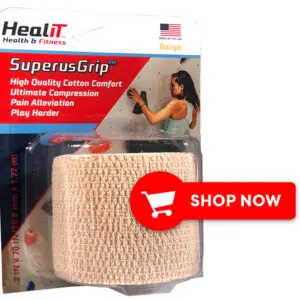
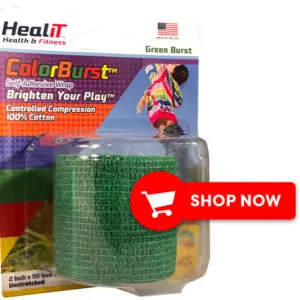
Healit’s self-adhering sports wraps, like the ColorBurst and SuperusGrip lines, are ideal for this purpose because they provide significant proprioceptive feedback while still allowing full, natural range of motion — unlike rigid tape, which completely restricts movement.
4. Muscle Vibration Dampening: Fighting the Fatigue You Don’t Feel
During high-impact activities — running, jumping, court sports — your muscles vibrate. These vibrations are the result of ground reaction forces traveling up through the skeletal system, and they are a primary contributor to muscular fatigue that compounds over the course of a game or long training session. The technical term for this is mechanical oscillation, and researchers have identified it as a meaningful cause of the ‘dead legs’ feeling athletes experience in the final stages of competition.
Compression wraps stabilize the muscle belly, reducing the amplitude of these oscillations. The practical result is that the muscles’ contractile units (the sarcomeres) expend less energy maintaining position and have more energy available for the actual work of running, cutting, and jumping. Multiple studies on lower-leg compression during running have shown a measurable reduction in reported muscle soreness and objective markers of muscle damage.
5. Thermal Regulation: Keeping Joints Warm and Limber
Tendons, ligaments, and joint capsules function best within a specific temperature range. Cold connective tissue is stiffer, less elastic, and more susceptible to injury — which is why athletes warm up before competition and why joint injuries are more common in cold-weather sports. The synovial fluid that lubricates the joint also behaves differently at lower temperatures, becoming more viscous and less effective.
A compression wrap acts as a simple thermal insulator, trapping the metabolic heat generated by muscle activity and maintaining a consistent temperature in the wrapped tissue throughout the duration of activity. For athletes with chronic joint issues — particularly those involving the Achilles tendon or the knee — this thermal benefit alone justifies keeping a sports wrap in the kit bag at all times.
Wrapping Right: Technical Tips for Maximum Benefit
Direction Matters
Always wrap distal to proximal — that means starting furthest from the heart and moving toward the core. Wrapping in the opposite direction creates a ‘dam’ effect that can trap fluid distally and increase swelling below the wrap.
The Right Tension
The goal is firm compression, not tourniquet pressure. A properly applied compression wrap should feel like a firm handshake: supportive and noticeable, but never painful. The clinical test: you should be able to slide two fingers under the edge of the wrap.
You don’t need a cryo-chamber or a percussive massage gun to recover like a professional athlete. A high-quality compression wrap — applied correctly, at the right time, with the right tension — delivers five distinct physiological benefits that support your body’s natural healing processes and help you get back to training sooner and stronger.
Healit compression wraps are made in the USA with materials and quality controls that ensure consistent performance every time you wrap. When quality matters, Healit has you covered.